Before obligations can be mapped, they must be understood in full. Contract review is the systematic analysis of every binding clause — identifying what is required, who is responsible, and what constitutes compliance. It is the first of the Six Core Principles in action: six analytical lenses applied to the contract before a single obligation is registered.
The contract is a legal instrument. It imposes binding obligations on both the Contractor and the Employer. COMAPS treats it as such — reading every clause with precision, identifying every obligation, and establishing who bears it and how compliance will be demonstrated.
On a major EPC contract, the Employer's Requirements alone comprise 26 volumes of binding technical, management, and compliance specifications. Each must be read in full, cross-referenced, and translated into actionable obligations before the mapping phase can begin. Experience in contract review — knowing what to look for and where risk is typically understated — is what separates a functional compliance framework from one that fails under scrutiny.
COMAPS applies a six-point review methodology to every contract engagement. No clause is read once and filed. Every obligation is interrogated for its purpose, its standard, its application, its timeline, its authority, and its method of compliance.
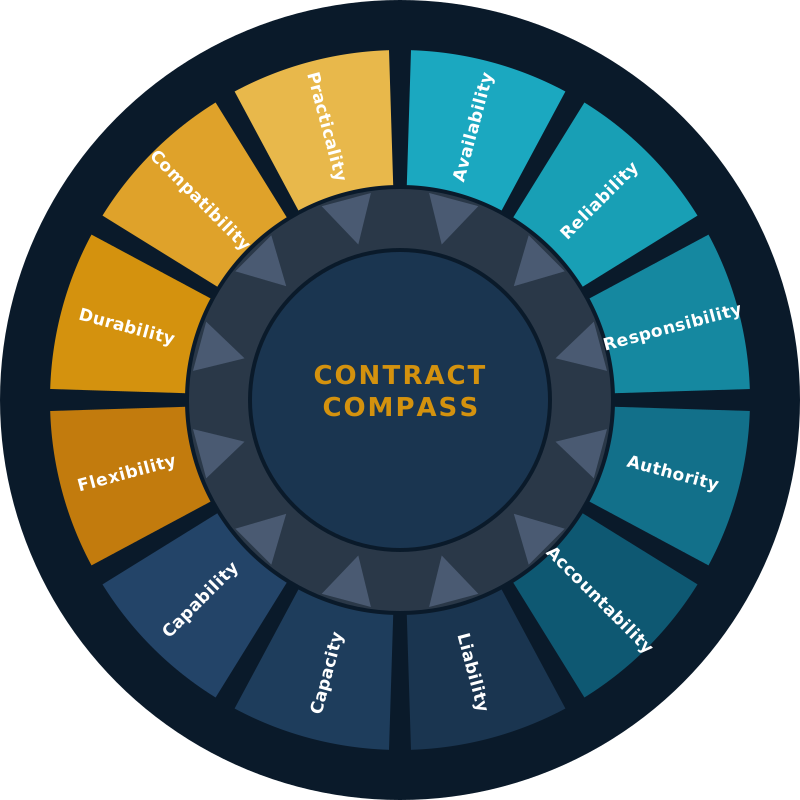
The COMAPS Contract Compass is applied to every clause. Each of the six lenses surfaces a different dimension of the obligation — ensuring that nothing is misunderstood, misassigned, or left without a defined method of verification.
Why does this obligation exist? Understanding the intent behind each clause prevents misinterpretation. An obligation read without context is an obligation mismanaged.
What exactly is required — scope, quality, format, and level of detail? Defined before execution begins, not interpreted under programme pressure when it falls due.
Where does this obligation apply — in the design, on site, offsite, or in the contract documentation? Location determines the responsible party and the verification method.
When must it be delivered? Sequence, dependencies, and lead times mapped against the Baseline Schedule — not estimated on the day the deadline is missed.
Who is responsible, and who has authority to accept? Every obligation is assigned to a named party. Every acceptance is issued by a named individual. Ambiguity of ownership is a contract risk.
How will it be executed and how will compliance be evidenced? Process, procedure, and formal record — so that compliance is demonstrable to any external party, not merely asserted.
On a major international EPC contract, the Employer's Requirements comprised 26 volumes — from overarching scope and design obligations through to discipline-specific technical specifications, performance testing, health and safety, environmental and social compliance, site security, and local employment obligations. Each volume contains dozens of clauses. Each clause imposes a specific obligation on one or both parties.
COMAPS reads every volume in full. The review process establishes which clauses are informational, which require a formal Contractor submission, which require Employer review and approval, and which constitute contractual Hold Points — mandatory gates that cannot be passed without written acceptance. This analysis is the prerequisite to the mapping phase. No checklist can be built from a contract that has not been read with this level of rigour.
The CMT's mandate is contract administration — not directing the works, but verifying, validating, and assuring the Contractor's compliance at every phase. The following table defines what COMAPS requires at each stage of the PPVC lifecycle. These requirements are established at the contract review stage and do not change as the project progresses.
| Phase | CMT Mandate | Contractor Obligation | Verification Evidence |
|---|---|---|---|
| PLAN | Review and approve all Contractor management plans, RAMS, and ITPs as Hold Points. Confirm that the Contractor's compliance framework references the governing ER clause in every submittal. | Submit all plans on the contractual schedule. Reference ER clause numbers in every submittal. Obtain CMT approval before commencing any activity to which the plan applies. | Written CMT approval of each plan. Distribution log. Signed Employer acknowledgements filed in EDMS. |
| PERFORM | Monitor the Contractor's activities against approved plans. Attend Hold Points and Witness Points. Record all site observations in daily diaries uploaded to EDMS within 24 hours. | Cooperate fully with CMT oversight. Provide advance notice of all Hold Points and Witness Points. Issue NCRs immediately for any deviation from an approved plan or ITP. | Daily diary EDMS uploads. ITP sign-offs. NCR register. Weekly meeting minutes with actions recorded. |
| VALIDATE | Inspect completed works. Review test results, as-built records, and NCR close-out evidence. Confirm compliance with all applicable ER clauses before issuing formal acceptance. | Submit objective evidence for every completed activity. Provide root cause analysis and corrective action records for all NCRs. Do not proceed until CMT re-inspection is complete. | Root cause analysis reports. Corrective action evidence. Re-inspection records. Signed test certificates. |
| COMPLETE | Issue formal acceptance or rejection against each ER checklist section. Sign off all 26 compliance volumes. Recommend Taking-Over Certificate only when all compliance conditions are satisfied and all outstanding deficiencies are resolved. | Submit final as-built records, O&M documentation, and a complete close-out evidence package. Compliance is evidenced — not self-declared. | ER checklist sign-offs across all 26 volumes. As-built programme. Final NCR closure report. CMT acceptance letter to Employer. |
On a major EPC contract, three distinct parties govern the execution process. The contract review phase establishes the precise role of each. COMAPS acts as the Employer's representative on site — all deliverables are reviewed by the CMT, all compliance decisions are issued by the CMT, and no works advance without CMT sign-off. The roles are contractually defined and not subject to informal modification.
Performs the works under the Contract. Prepares and submits all deliverables — plans, design documents, ITPs, and reports — through the EDMS. Responds to all CMT comments within the contractual review period. Obtains CMT acceptance before advancing past any Hold Point.
Role: Designer & Builder
Holds the Contract and defines requirements through the Employer's Requirements. Provides the project site, access, and approvals. Receives all completed works and project deliverables. Final authority on acceptance decisions, variations, and Taking-Over. Supported and advised by the COMAPS CMT throughout.
Role: Project Owner & Principal
Administers the Contract on behalf of the Employer. Reviews and formally accepts or rejects all Contractor submissions. Issues Hold Point clearances, NCRs, and compliance decisions. Maintains the obligation register, design review register, and all compliance records in the EDMS.
Role: Contract Administrator & Gatekeeper
The contract and its Employer's Requirements — taken together as a single binding instrument — define not only what must be built, but how it must be managed. Contract review surfaces twelve management pillars that run across every project phase and that are as legally binding as any technical specification. COMAPS identifies, registers, and owns each pillar from contract award to final closeout. Each is assigned a CMT lead. Each has a compliance checklist. Each is reported on at every progress meeting.
Method statements, RAMS compliance, incident reporting, emergency response, and H&S plan obligations — all identified and assigned at review.
ESAP obligations, environmental monitoring, community engagement, grievance mechanisms, and social reporting requirements across all project phases.
Quality Management Plan, ITP regime, NCR procedure, material approval process, and all quality assurance obligations mapped from contract documents to execution.
Baseline Schedule obligations, programme submission requirements, progress reporting cadence, recovery plan provisions, and time-at-large risk identified and registered.
Risk register framework established, risk allocation between parties confirmed, and risk management plan obligations identified during the contract review phase.
Third-party interfaces — grid connection, lender's engineer, government authorities, and adjacent contractors — identified, obligations extracted, and interface register established.
Contractual communications protocol — notice formats, transmission methods, response periods, and distribution requirements — established and confirmed with all parties at mobilisation.
Variation process, change order authority limits, change register obligations, and the contractual conditions precedent for a valid variation claim — all identified and documented before works commence.
Local employment obligations, labour standards, key personnel approval requirements, competency verification, and HR reporting obligations extracted and assigned at review.
Access control obligations, security plan requirements, personnel accreditation, and the protocol for security incidents — identified during contract review and formally documented in the administration procedures.
Contract sum vs earned value, independent payment certificate assessment, substantiated deductions, variation account maintenance, and EDMS-based final account — all CMT-administered.
Stakeholder register maintained, engagement actions logged, formal escalations tracked, and monthly stakeholder report issued to Employer — obligations identified and owned from contract award.
Under the FIDIC Silver Book 2nd Edition (2017), the Contractor bears single-point responsibility for the entire EPC scope. The Employer's Representative — the role COMAPS occupies — holds formal authority under Clause 3 and defined obligations across ten further clauses. Each clause below carries a specific CMT action. None are advisory. All are contractual.
The CMT operates as the ER. Cl. 3.5 requires determinations to be made fairly, "taking due regard of all relevant circumstances." The ER is not deemed to act for the Employer on matters of determination — neutrality is a contractual obligation, not a choice. All instructions issued in writing; verbal instructions have no standing.
Cl. 4.1 places design responsibility and fitness for purpose entirely on the Contractor, backed by an indemnity under Cl. 17.4. CMT verifies design intent at each Hold Point against the Employer's Requirements — not just the technical specification. Performance bond register administered; reviewed when contract price variations exceed 20%.
All design submittals reviewed and formally accepted, commented, or rejected. Basic Design and Detailed Design acceptance are mandatory Hold Points before construction commences. Comment categories enforced. Resubmission cycles tracked in the design register. No design is self-accepted.
CMT enforces the ITP at every critical activity. Hold Points are not waived without written CMT acceptance; Witness Points are attended or formally waived. NCRs issued for all deviations from approved plans, specifications, or ITP requirements and tracked to evidenced closure through the full PPVC lifecycle.
Baseline Schedule approved as a Hold Point under Cl. 8.3. CMT independently validates progress against the programme. Cl. 8.4 introduces a reciprocal advance warning obligation. EOT claims assessed under Cl. 8.5. Delay damages cap (Cl. 8.8) tracked — carve-outs apply for fraud, gross negligence, and deliberate default.
CMT gates the full completion sequence. Commissioning Plan accepted as Hold Point. Dry, wet, and performance tests witnessed; results certified. Taking-Over Certificate recommended only when all conditions are met. DLP defect notices issued in writing and remediation accepted. Performance LDs assessed under Cl. 12.4(b).
No variation is executed without a formal written CMT instruction. CMT assesses cost and programme impact, reviews Change in Law entitlements against project-specific documents, and challenges any scope creep. Variation register maintained with agreed valuations. Employer may also instruct a decrease in Contract Price under changed law provisions.
CMT reviews each payment application and provides supporting particulars for any deductions — mandatory under the 2017 edition. Earned value assessed independently of Contractor reporting. Advance Payment security expiry tracked. Cl. 14 requires the Contractor's Representative to be formally appointed before any payment is made.
The 2017 edition equalises the time bar — it now applies to both Employer and Contractor claims. CMT must log all potential claim events, issue or respond to notices within 28 days of becoming aware, and maintain a fully evidenced claims register. Informal site communications, progress reports, and meeting minutes cannot substitute for formal Notices under Cl. 20.2.
COMAPS maintains the contemporaneous evidence base that is the primary instrument of dispute avoidance. Every NCR, Hold Point record, site observation, and notice response is filed in the EDMS with a date stamp. If a matter reaches the DAAB, the CMT record is the Employer's position — built over months, not assembled retrospectively.
FIDIC Conditions of Contract for EPC/Turnkey Projects, 2nd Edition (2017), reprinted 2022 with amendments.
Hold Points are identified during the contract review and registered before works commence. They are contractual gates — works cannot proceed past a Hold Point without formal written CMT acceptance. COMAPS maps every Hold Point against the ten project phases, ensuring that the compliance framework is aligned to the actual execution sequence from Mobilisation through to Project Closeout.
The principle is absolute: follow-on works do not commence past a Hold Point without formal written CMT acceptance. Programme pressure is not grounds for waiver.
The COMAPS review methodology is designed to operate within any FIDIC contract structure. Whatever the form — EPC/Turnkey, Design-Build, Construction, or MDB Harmonised — the same structured review and compliance framework applies.
Effective contract administration requires more than an understanding of the obligations — it requires a procedural framework that ensures compliance is tracked, documented, and demonstrable throughout the project lifecycle.